For about two years now, the AI coding agent race has been a party Meta wasn't invited to. Anthropic had Claude Code. OpenAI had Codex. Google shipped Gemini CLI. Cursor turned the workflow into a multi-billion-dollar business.
Meta, meanwhile, was the company that gave everyone free model weights and then mostly watched other people build the tools.
That changed this morning. Meta Superintelligence Labs dropped Muse Code, a terminal coding agent, in beta, along with Muse Spark 1.2, a coding-focused model built specifically to run inside it (Meta AI Research).
Install is the now-obligatory one-liner:
curl -fsSL https://dev.meta.ai/install.sh | bash
For now, it's on macOS and Linux only. No GUI, no IDE extension, no web app. Just the terminal, which in 2026 is the most fashionable place to be.
The actual interesting part
Every lab ships a coding agent now, so the pitch has to be how rather than what. Meta's answer is architectural, and it's a legitimately different bet.
Most agent harnesses spawn a sub-agent when they need one, let it do a job, and kill it. Muse Code instead runs a main agent loop plus a set of persistent background agents that stay alive for the entire session.
They accumulate context as they go instead of re-reading your codebase from scratch every time someone asks a question. They decide on their own when to report back. Meta's argument is that this cuts latency and, more importantly, cuts how often you have to babysit the thing through a multi-step task.
Zuckerberg's framing: when a job gets big enough, the agent fans out into parallel sub-agents working in isolated git worktrees, so your actual working copy never gets touched. He claims internal testing had it building six features for a game simultaneously without collisions.
The second piece is the runtime. Muse Code writes everything, every model call, every tool invocation, every approval you grant, every edit, to a local append-only event log.
Meta calls it replay-exact and restart-safe: if the process dies, the agent picks back up exactly where it stopped rather than waking up confused about what it was doing.
If you've ever had a long agent run implode at hour three and lost the whole thread, you understand why this is the feature people will actually care about. It's also, notably, an audit log, which is going to matter to exactly the kind of enterprise buyer Meta is chasing.
Three built-in commands ship by default: /plan turns a request into an approval-gated plan, /grill stress-tests that plan until it stops falling over, and /goal just grinds toward an objective.
Numbers, with the usual asterisk
Meta reports 82.9% on Terminal-Bench 2.1 and 59% on DeepSWE 1.1, beating Grok Build 4.5 and Gemini 3.6 Flash on the latter.
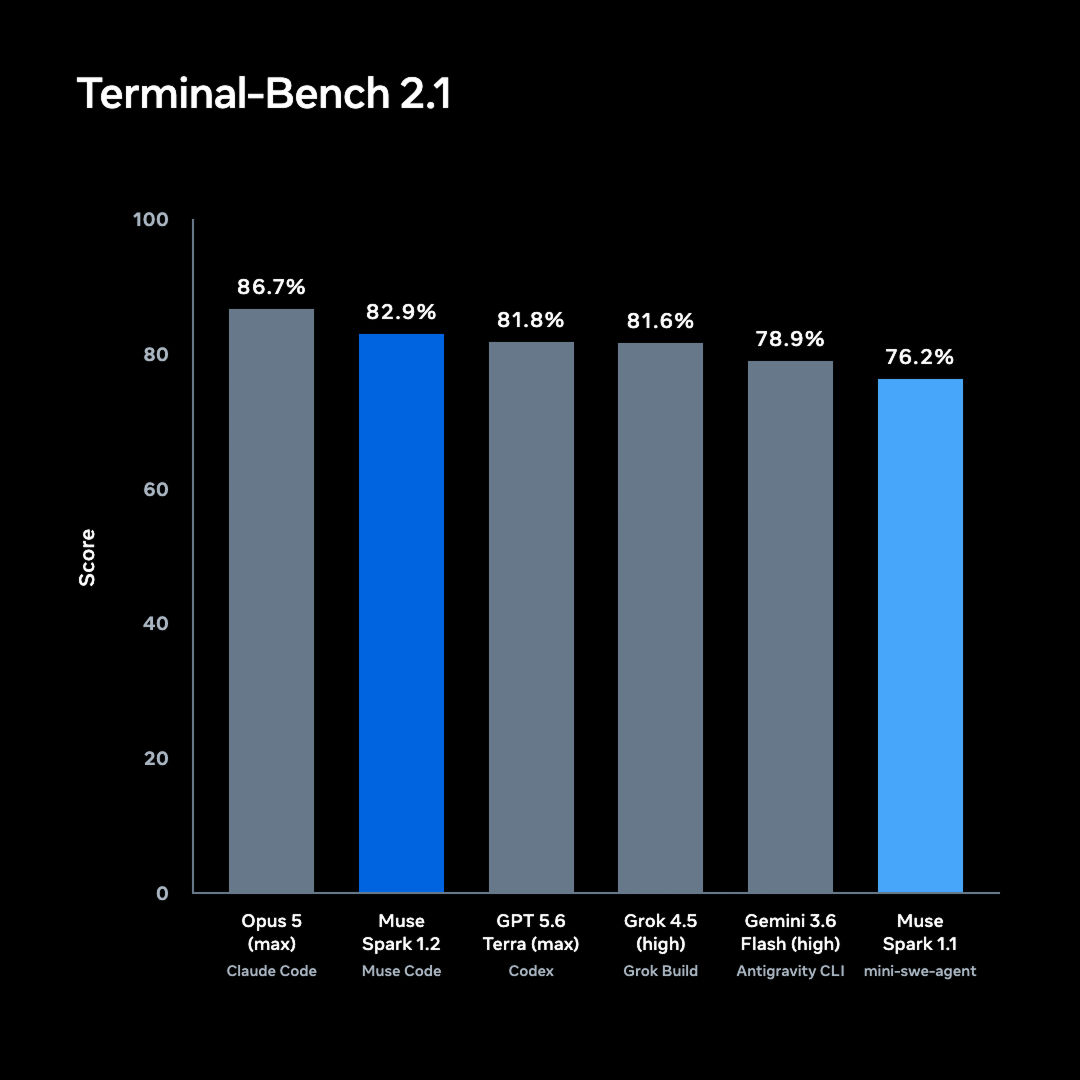 Source: https://research.meta.ai/blog/introducing-muse-code-and-muse-spark-1-2
Read that comparison set carefully. Those are real competitors, but they aren't the flagship models most people benchmark against when they're claiming the frontier, and Meta isn't claiming the frontier here either, to be fair.
The blog post explicitly calls this a step toward it, with bigger models coming. All of these numbers are self-reported and less than a day old. Nobody outside Meta has stress-tested any of it yet. (The full methodology report is where the evaluation details live, if you want to check the setup yourself.)
The more convincing demo is the kernel optimization case study: they turned the agent loose on GPU kernels for NVIDIA Hopper hardware and let it run 1,000+ tool calls over as long as 24 hours, writing, compiling, profiling, and iterating against a baseline, with real speedups.
Whether or not you trust the benchmark table, a 24-hour autonomous run that doesn't collapse into incoherence is a meaningful claim about the harness.
The pricing is the strategy
Here's where it gets genuinely interesting, and where Meta is clearly making its play.
Standard tier: $1.25 per million input tokens, $0.15 cached, $4.25 per million output.
Contributor tier: $0.10 input, $0.002 cached, $0.20 output: roughly 12x cheaper on input and 21x cheaper on output, with rate limits cut from 3,000 requests/minute to 60 in exchange for explicit permission to train future Meta models on your prompts and completions.
VentureBeat made the observation that's hard to un-see once you've seen it: this is the Llama strategy with the terms inverted.
The old deal was free weights for ecosystem mindshare. The new deal is cheap tokens for training data. Meta, the company that spent years arguing open source was the path forward, is now asking you to either pay per token for a model you can't inspect, or subsidize your own usage with your code.
Whether that's cynical or just honest depends on your mood. Every lab wants your agentic trajectory data. Meta is the first to put an explicit price tag on it and let you decide.
Competitively, it's a real wedge. Claude Code and Codex both start around $20/month subscriptions before usage billing. Muse Code has no subscription floor at all, and the contributor tier is aggressive enough that hobbyists and students may reach for it purely on cost. Muse Spark 1.2 is also available on OpenRouter, so you can swap it into whatever harness you already use.
So should you install it?
If you're a solo dev or a student burning through tokens on side projects, the contributor tier is priced to be irresistible and you should probably take it for a spin and see how it compares to what's out there.
If you're just curious about the architecture, persistent background agents and a crash-safe event log are genuinely different design choices, and they might become the features that get you to convert.
It's a beta from a company that badly needs an AI win in front of impatient investors, shipped hours ago, with zero independent verification. Wait a week. Let the early adopters find the sharp edges. Then decide whether the price is worth it.
Sources
Primary