The developer community woke up this week to shocking news: Tailwind Labs has laid off 75% of its software engineers, reducing the team from four engineers down to just one.
Now, this is not uncommon at all in the startup world. Teams grow and shrink on the daily as the underlying business model morphs and finds its shape.
However, for a framework that's the most popular CSS framework among respondents to the 2025 State of CSS survey, used by 51 percent of them, this news hit hard. So what exactly is going on, and should developers be worried?
The Perfect Storm
The situation came to light in an unusual way. When an open-source contributor submitted a pull request in November 2025 to make Tailwind's documentation more accessible to AI language models, founder Adam Wathan declined it. His explanation revealed a crisis that had been brewing behind the scenes.
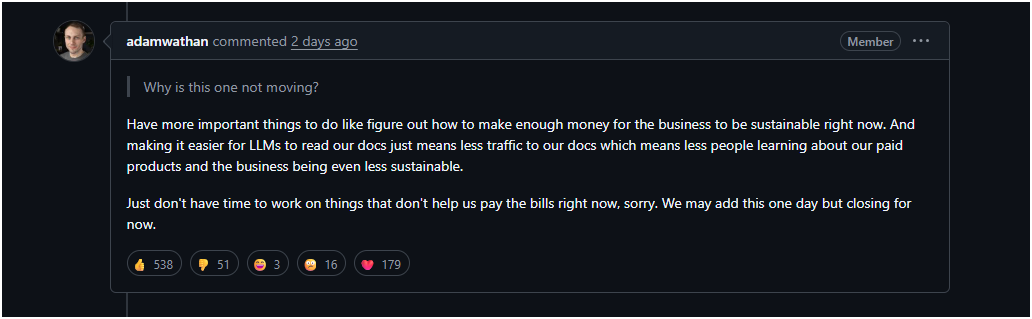
The numbers paint a stark picture. Tailwind's CSS framework is now seeing around 75 million downloads a month, and usage continues to grow rapidly. Yet paradoxically, revenue is down by almost 80%. Traffic to the documentation site has fallen roughly 40% since early 2023.
How can a framework be more popular than ever while the company behind it struggles to survive? The answer lies in how developers are now interacting with the tool in 2026.
AI Broke the Business Model
Tailwind Labs' revenue model depended on a relatively straightforward funnel: developers would Google CSS solutions, land on Tailwind's documentation, discover their paid products like Tailwind UI (premium component packages), and make purchases.
In full transparency, I only recently adopted Taliwind and many of my projects still run on traditional CSS.
However, it is true that my increased adoption was mainly due to AI models being so good at Tailwind and pretty much providing it in most responses.
AI coding assistants have completely bypassed the original business flow.
Developers now type prompts into ChatGPT, Claude, or Cursor and receive production-ready Tailwind code instantly, without ever visiting the documentation site. The AI tools train on Tailwind's freely available docs, then serve that knowledge through their own interfaces. Users pay $20-200 per month for these AI subscriptions, but none of that revenue flows back to Tailwind Labs.
Wathan captured the painful irony in his response: the framework is growing faster than ever, but there's no longer any correlation between making Tailwind easier to use and making the business sustainable. Making documentation more AI-friendly might actually accelerate the problem by further reducing human traffic to the site where commercial products are discovered.
Should Developers Be Worried?
The short answer is: not immediately, but the situation deserves attention and definitely respect for the folks working on it behind the scenes.
The framework isn't going anywhere soon. Tailwind CSS is open source, and the core functionality will continue to work. The remaining team includes the three co-founders plus one engineer, and they've committed to maintaining the project. For day-to-day development work, nothing changes immediately.
Updates may slow down. With a drastically reduced team, the pace of new features and improvements will likely decrease. The project won't become abandonware overnight, but the rapid iteration developers have enjoyed may not continue at the same pace.
This is a broader industry warning. Tailwind's crisis isn't unique. Any developer tool, documentation site, or educational resource that depends on web traffic for monetization faces similar pressures. Bootstrap, Material UI, Chakra UI, and countless other projects built on similar business models are watching cautiously.
The Open Source Dilemma
The situation highlights a fundamental tension in open source. How do you sustain development of free software that millions of developers depend on and that seems to be growing exponentially?
Wathan's emotional responses in the GitHub thread revealed the human cost. When criticized for prioritizing revenue over community needs, he pushed back, explaining that without sustainable funding, Tailwind becomes unmaintained abandonware. The framework's popularity doesn't pay the bills if users never visit the site where paid products are promoted.
Some developers in the discussion called for corporate sponsors like Vercel, Shopify, GitHub, and NASA (all heavy Tailwind users) to step up with financial support. Others questioned whether venture-backed AI companies that train on open-source documentation should compensate maintainers. These questions don't have easy answers.
But as a long-time startup founder, I completely understand where Wathan is coming from. Passion and users don't necessarily equate to long-term financial success. I personally love building complex SaaS products that 1000's of people rely on monthly, but I can only do that to the best of my ability if I can comfortably pay the bills and have a roof over my head.
What Comes Next?
Wathan mentioned exploring ways to offer AI-optimized documentation without making the revenue situation worse, though he can't prioritize it currently. Google's AI team announced they're becoming a sponsor of the project, which is a positive development but unlikely to solve the fundamental problem.
The broader lesson extends beyond Tailwind. As AI tools increasingly mediate how developers access knowledge, the economics of developer tooling are being rewritten. Projects that thrived by being helpful and well-documented now find those same qualities working against their business sustainability when AI serves as the intermediary.
The Bottom Line
For developers currently using Tailwind, keep building. The framework remains stable, widely supported, and isn't disappearing. But start thinking about sustainability. Consider sponsoring the projects you depend on, advocate for your employer to contribute to open-source tools your team uses, and recognize that "free" software often isn't truly free, someone is paying the cost.
For the industry - Tailwind's story is the canary in the coal mine. We need new models for sustaining open-source development in an AI-mediated world. The old model of "build great documentation, monetize through discovery" just broke spectacularly.
What comes next will determine whether the open-source ecosystem thrives or slowly withers as maintainers burn out.
The framework you're using today is probably fine. The framework you'll want to use in five years? That's the real question Tailwind's crisis forces us to confront.
Walt is a software engineer, startup founder and previous mentor for a coding bootcamp. He has been creating software for the past 20+ years.